Korean bujeok talismans are often compared to Chinese fu talismans. Both are ritual papers composed of characters, sigils, and symbolic seals designed to direct spiritual force toward a specific desire.
A bujeok is not just decorative calligraphy, or art. Or possessed or haunted objects like in the movies.
It is ritual technology.
They functioned as protective seals, command symbols, healing instruments, and spiritual contracts, and energetic containers. They were used in homes, businesses, on the body, and in formal ceremonies depending on their purpose.
There are three ways to produce a bujeok - hand drawn, wood block stamp and digitally drawn, a reflection of our modern times.
The most common form people recognize is yellow paper with red ink. And historically in the past, bujeok were also created on white paper and written using mineral-based inks. In certain ritual contexts, blood or other materials were incorporated, depending on the tradition and purpose. They were also consumed after burning it into ash for health outcomes.
Stamped bujeok are not a modern shortcut. Museum of Shamanism archives in Korea preserve carved wooden block stamps that were used to imprint talismans repeatedly and consistently. Replication has historical precedent and shows that method of production alone does not determine legitimacy.
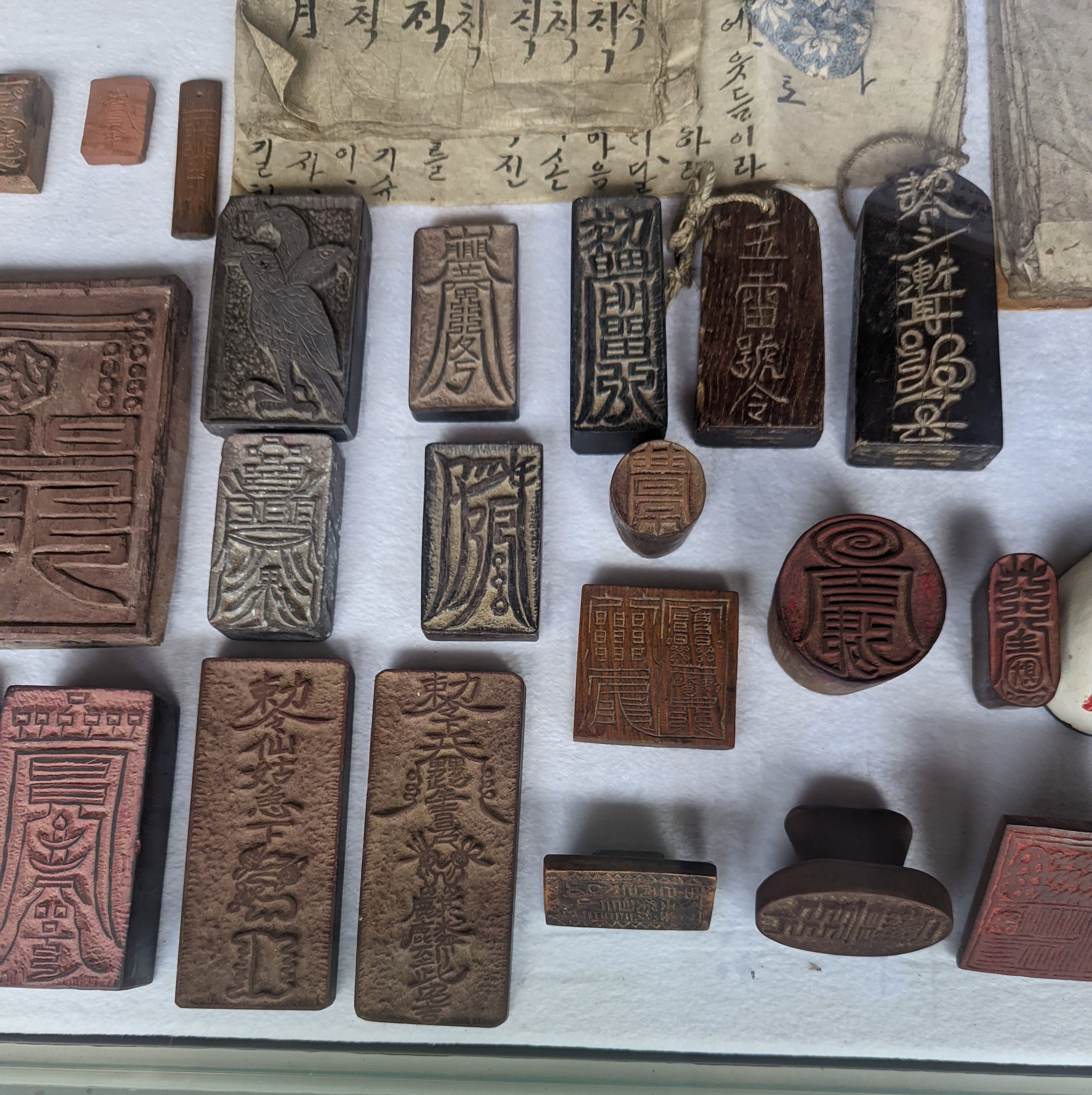
Museum of Korean Shamanism - Seoul

Museum of Korean Shamanism - Seoul
There are different ways that people believe where the power comes from - the person who is drawing it, or who is praying over it, or from the symbols themselves. They are encoded cosmological diagrams. Each line, character, and seal corresponds to specific forces and directives, or containers to hold.
Without authority and activation, a bujeok is ink on paper. Without correct structure, intention alone is insufficient. Power is generated through alignment between symbol, practitioner, and ritual framework.
Regardless if you use one bujeok or multiple compounded together, the process spans multiple days.
In my own practice, it requires purification, preparation, and energetic discipline before the talisman is even written. Timing, internal alignment, and ritual conditions all matter.
This is not mass production.
Bujeok are not aesthetic objects they are ritual technology crafted within a spiritual system. Contrary to popular beliefs, bujeoks are not exclusive to mudangs, it was drawn by monks, Taoist sage, and people with energies.
